
Last updated September 10, 2026
Full 25-point door and opener safety check with every visit - springs, cables, rollers, tracks, and your LiftMaster or Chamberlain opener included
You get a price before we start. It does not change when the truck arrives.
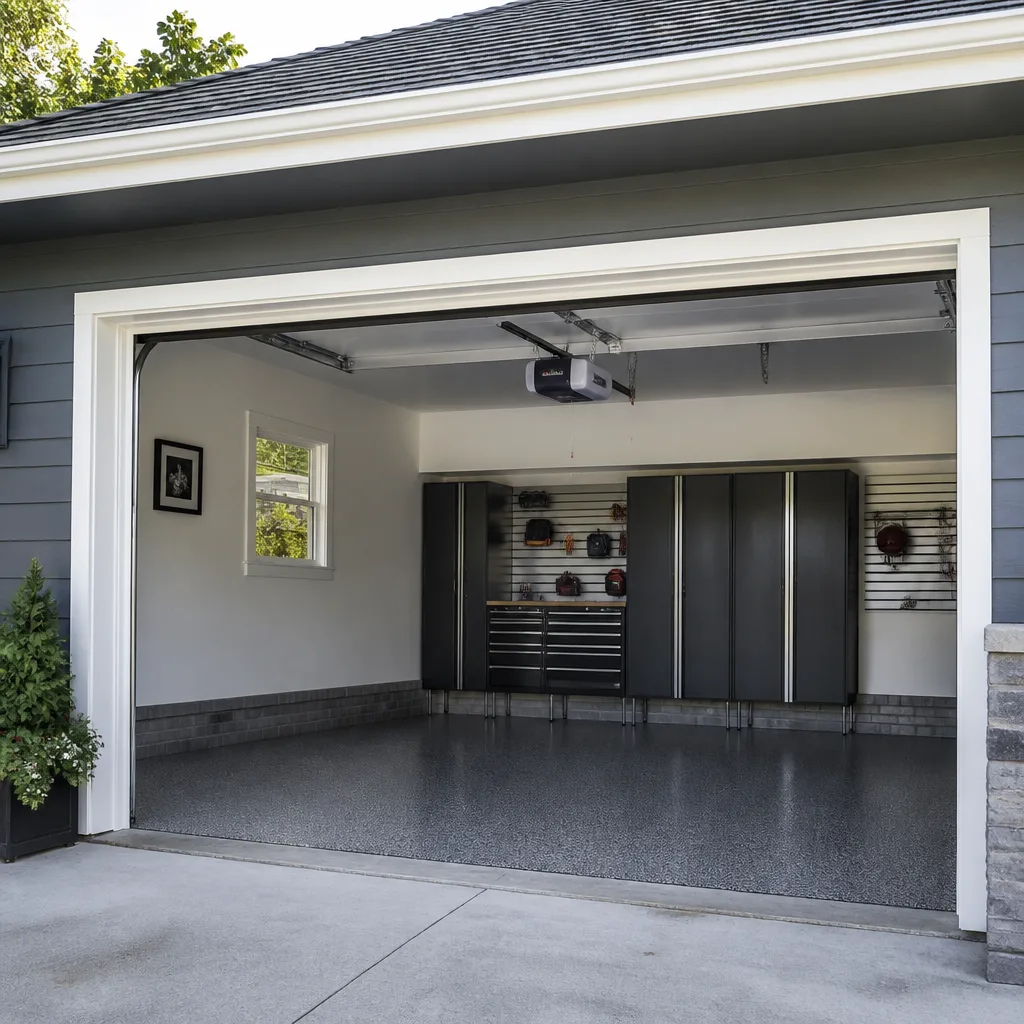
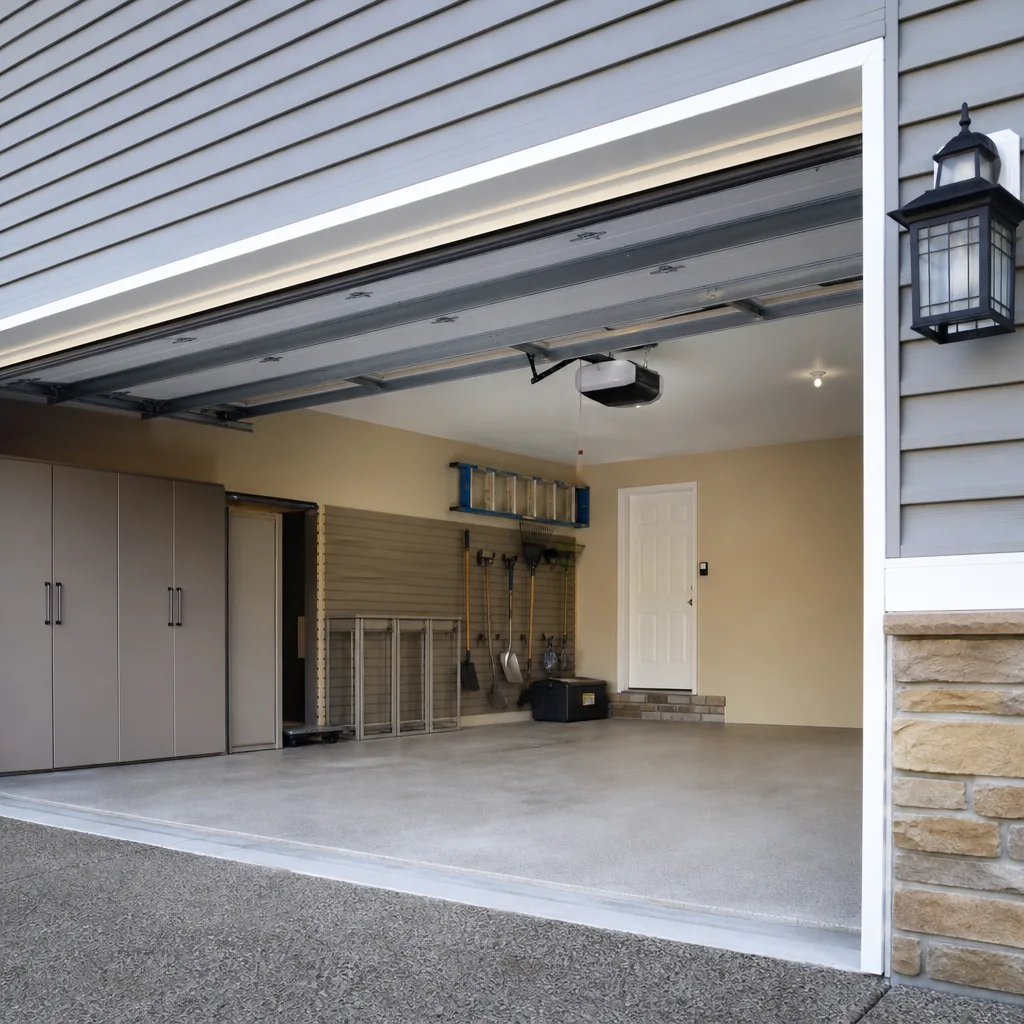
 Before
 After
After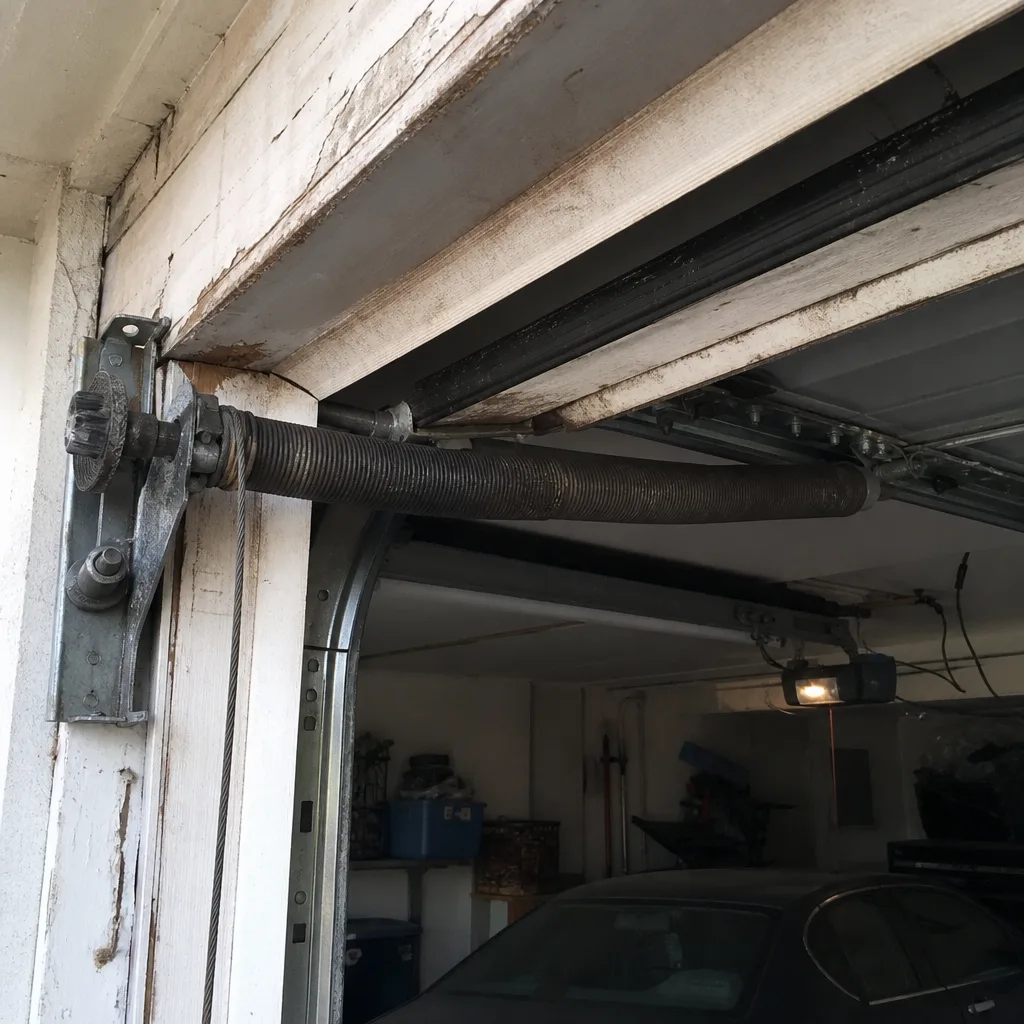 Before
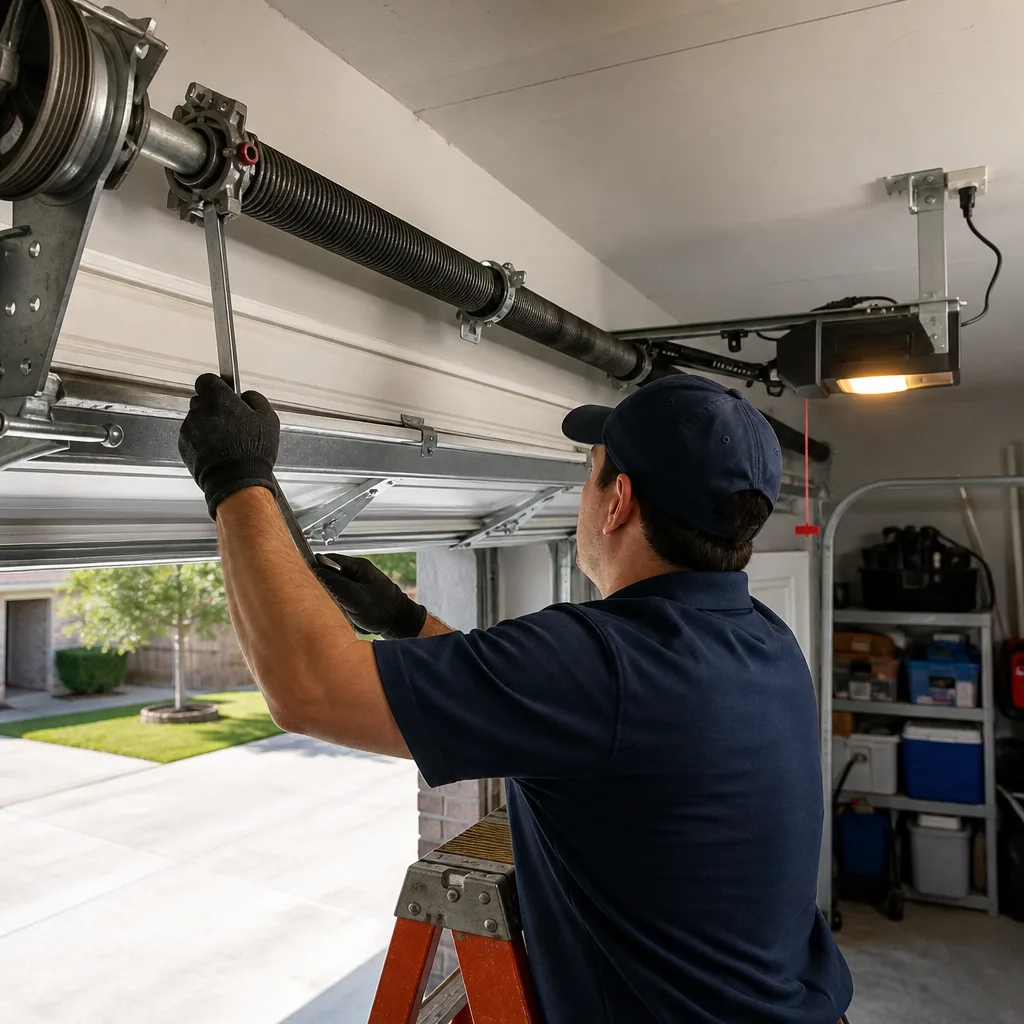 After
After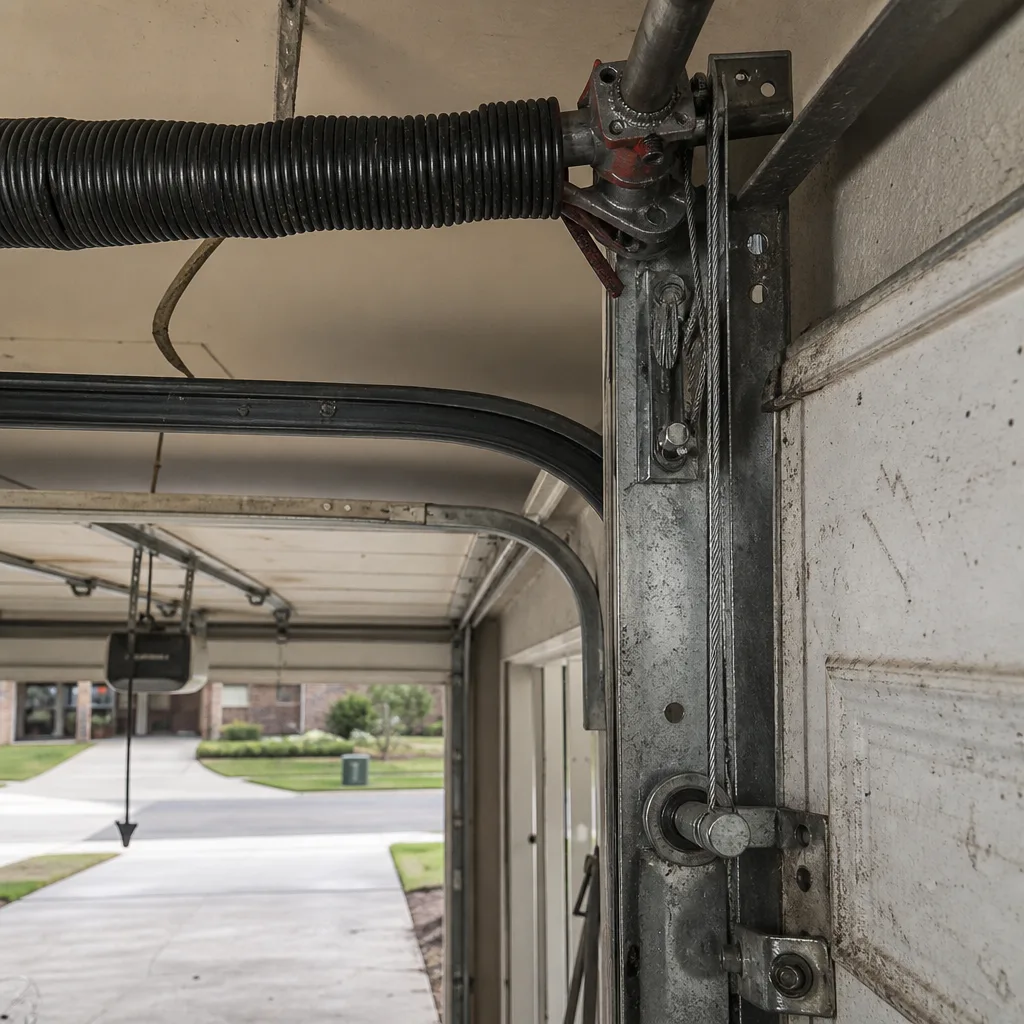 Before
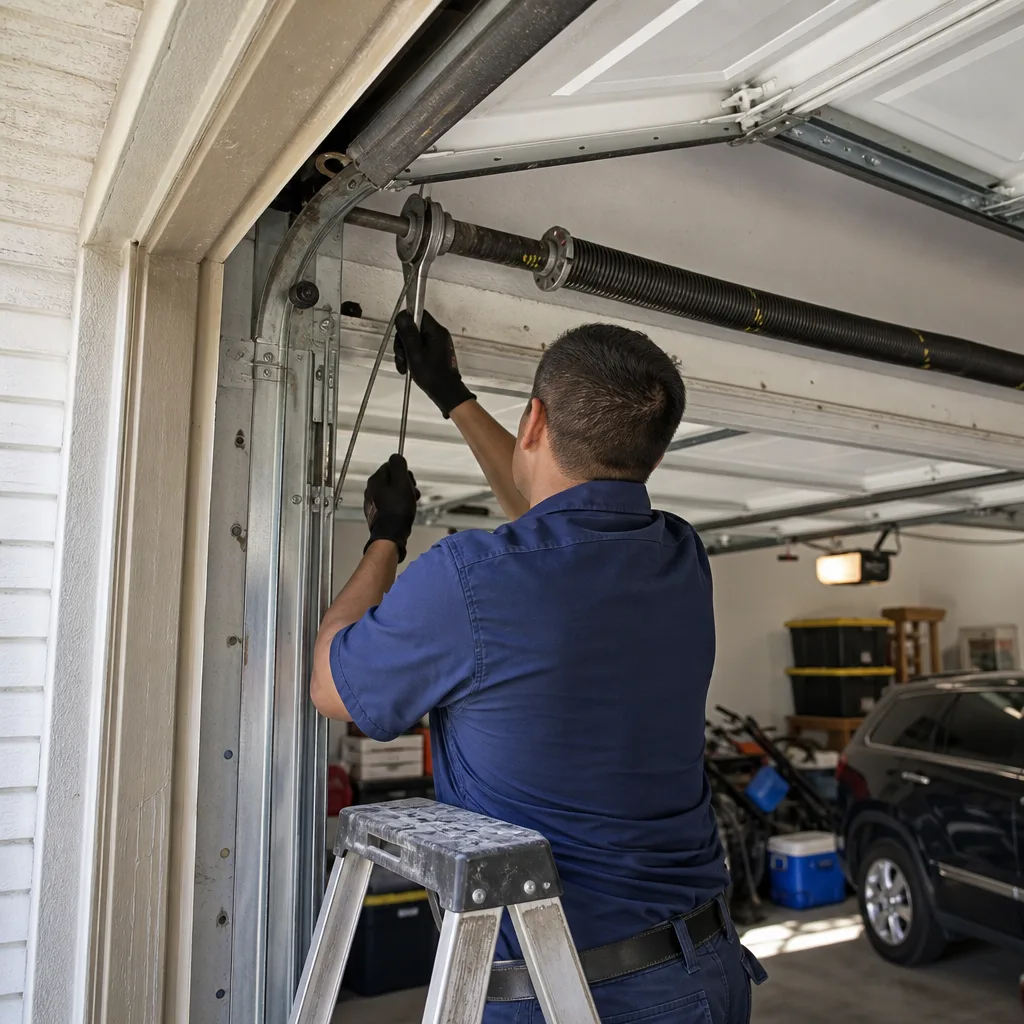 After
AfterGarage Door Warning Signs: A Cinco Ranch Homeowner’s Reference Guide
The grinding noise your door makes every third open is not the door “warming up.” In Cinco Ranch, where garage doors cycle twice as often as they do in cooler climates thanks to year-round heat, Otto has heard that explanation from homeowners right before a broken torsion spring dropped a 400-pound door onto a car hood. This guide names those warnings plainly. You’ll learn which noises mean “keep an ear on it” and which mean “stop using the door today.” You’ll also learn the monthly test that tells you whether your door would crush a child’s bicycle or stop on contact.
Quick Answer
The most common garage door warning signs in Cinco Ranch are grinding or popping noises, a door that hesitates before moving, rust staging along panel bottoms, and a door that closes unevenly or fails to reverse on contact. Most of these signal worn springs, stretched cables, or a failing opener motor, not normal aging. You can check several of them yourself in under ten minutes, and catching them early is the difference between a $200 repair and an $800 emergency replacement on a Sunday night.
Table of Contents
- A Sound-by-Sound Breakdown: What Your Door Is Telling You
- Cinco Ranch Humidity and Rust: What’s Cosmetic, What’s Structural
- The Response-Time Test: Why a Slow Door Is a Failing Motor
- The Uneven Bottom Gap: A Cable Problem Wearing a Seal’s Clothes
- The Monthly Safety Reversal Test Every Homeowner Should Run
- Understanding Spring Cycles: Counting Mileage on Your Door
- Roller and Track Wear: What Those Side Noises Mean
- Weather Seal Damage: The Sign You Can See From Your Driveway
A Sound-by-Sound Breakdown: What Your Door Is Telling You
A garage door makes three kinds of noises worth separating: scraping, grinding, and popping. Each points to a different mechanical issue, and confusing them costs Cinco Ranch homeowners money because they either ignore a serious one or overreact to a minor one.
Scraping is the sound of metal dragging against metal. It’s rhythmic, repeating once per panel as the door travels. In nearly every case, scraping means a roller has seized or worn flat and is now dragging along the track instead of rolling through it. The fix is usually a roller replacement, which runs $20 to $40 per roller depending on whether you need standard steel or quieter nylon rollers. This is a repair you can schedule. It’s not urgent the day you notice it, but let it go for months and the dragging roller wears a groove into the track, at which point you’re replacing track sections too.
Grinding is deeper than scraping. It sounds like rocks in a blender and often comes from the opener itself. Inside the opener, a plastic gear called the drive gear meshes with the motor shaft. Over five to ten years, that gear wears down, especially on doors that are heavy or unbalanced. When you hear grinding from the opener housing, the gear is shedding teeth. You might get a few more weeks out of it. You might get one more open. In Cinco Ranch, where openers run frequently because garages double as workshops and entry doors, we replace more worn drive gears on LiftMaster and Chamberlain units than any other opener part. If the grinding is coming from the opener, stop using the wall button and call someone. If it’s coming from the door itself, it’s usually a spring or roller issue, which we’ll cover below.
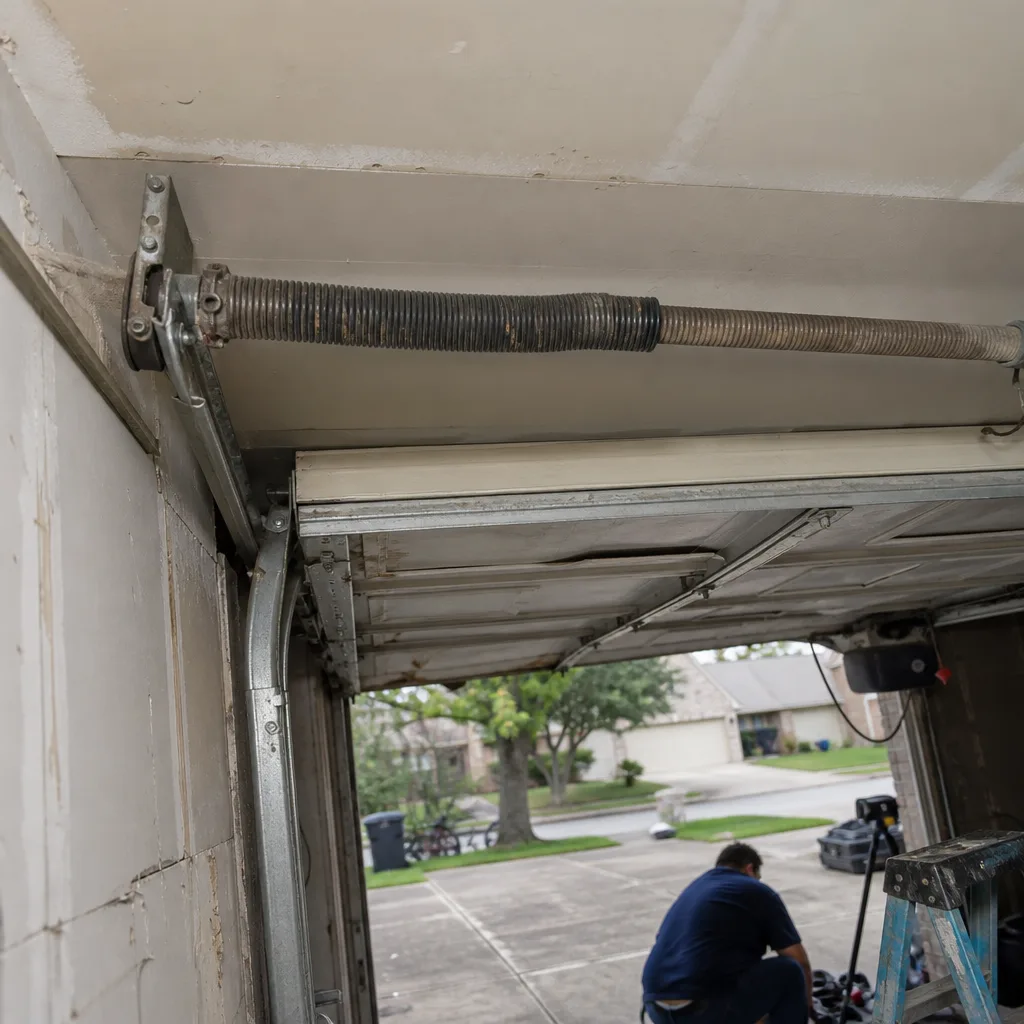
Popping is the sound nobody wants to hear, because popping is the sound a torsion spring makes when it starts to separate. A torsion spring is a tightly wound coil of steel mounted above the door. Over thousands of cycles, it develops microscopic fatigue cracks. Eventually, one of those cracks grows, and you hear a pop, like a gunshot from inside your garage. Sometimes the door still works after a single pop. It should not be used again. A popped spring under tension is unpredictable, and the second half of that spring can break without warning, sending shrapnel across the garage. We treat any popping sound as an emergency. Call someone same-day.
Here’s the urgency ranking, plain:
- Scraping: Schedule within a week or two. Roller and track wear accelerates.
- Grinding from opener: Stop using the door. Call same-day or next-day.
- Popping from spring area: Stop using the door immediately. Call same-day. Do not attempt to open the door manually.
Cinco Ranch Humidity and Rust: What’s Cosmetic, What’s Structural
Cinco Ranch sits in a humid subtropical climate. Your garage door sits in it with you. Most mornings, condensation forms on the interior face of steel panels, especially in garages without ceiling insulation or proper ventilation, which is why seasonal garage door care for Cinco Ranch matters year-round. That moisture is the quiet agent behind the rust you’ll eventually see along the bottom edge of your door.
Rust on a garage door appears in two stages, and knowing the difference matters.
Early staging looks like small, raised orange or brown specks, often clustered along the bottom panel near the corners and around the strut lines where the horizontal reinforcement bars run. At this stage, the panel itself is still solid. The rust is in the paint layer, not through the steel. You can test it with a screwdriver handle: tap the area. If it rings, the metal underneath is intact. Early staging is cosmetic and fixable. Light sanding, a rust-inhibiting primer, and a matched-color touch-up paint keep it from advancing. We’ve seen Cinco Ranch doors with ten-year-old early rust that never progressed because the homeowner caught it and treated it.
Structural rust is different. The telltale sign is blistering, where the paint forms raised bubbles, and when one of those bubbles pops, you see a pinhole that goes all the way through the panel. That’s not cosmetic anymore. That panel is losing its load-bearing integrity. On a steel door, one structurally rusted bottom panel means the door’s reinforcement is compromised, and the panel will eventually fail where the bottom bracket bolts through it. That’s when doors sag, brackets tear loose, and cables snap under the unbalanced load. If you can see a pinhole through any panel, you’re looking at panel replacement or a new door, not paint.
Clopay and Amarr both build doors with rust-resistant galvanized steel and factory-applied finishes designed for Gulf Coast climates. If your door is older than 15 years and showing blister rust in multiple panels, replacement is usually cheaper than chasing patch panels. A new steel door with a baked-on finish will outlive two patch jobs. If you’re unsure which stage you have, a garage door repair in Cinco Ranch inspection costs you nothing to schedule a look.
The Response-Time Test: Why a Slow Door Is a Failing Motor
Here’s a test you can run in thirty seconds. Stand at your wall button and press it with a stopwatch or your phone timer running. In a healthy garage door system, the door begins moving within one second of the button press. If your door takes two tries to respond, or if it sits there for three, four, five seconds before jerking into motion, the problem is almost never the remote battery.
Homeowners replace remote batteries, swap out wall buttons, and even buy new keypads trying to solve a door that hesitates to respond. In our experience across Cinco Ranch, the culprit is the opener motor’s capacitor or the logic board. The capacitor is a small cylinder inside the opener that stores the burst of electricity the motor needs to start under load. Capacitors degrade with heat and age. When the capacitor fails, the motor doesn’t get the starting jolt, so it hesitates. A door that takes two tries to open is a motor starving for starting current, and eventually, that starvation becomes total: one press, a click, and nothing.
A failing logic board produces similar hesitation, often paired with phantom operations, like the door opening on its own or lights flickering inside the unit. That’s the board’s receiver circuit degrading, and it’s the one repair we always recommend a professional handle, because the board controls the safety reversal circuit. A miswired board is a reversing door that doesn’t know it’s supposed to reverse.
The rule of thumb: if the door responds instantly every time but the remote has short range, that’s a remote issue. If the door hesitates or stutters consistently from every control, wall button included, that’s the opener. Motors in Cinco Ranch run hot. Ten years is a full life for an opener in this climate. If yours is older and hesitating, start budgeting for a garage door opener in Cinco Ranch replacement before it fails on a Friday evening.
The Uneven Bottom Gap: A Cable Problem Wearing a Seal’s Clothes
Stand back from your closed door and look at the line where the bottom of the door meets the concrete floor. If you see daylight on one end, most homeowners assume the rubber weather seal at the bottom is worn. That’s the easy answer. In a majority of cases, it’s also the wrong one.
A garage door rides on two cables, one on each side, and those cables are what keep the door level as it travels. They’re attached to the bottom brackets and wrap around drums at the top. When one cable stretches, or when one drum slips a fraction of an inch on the shaft, that side of the door travels slightly farther than the other. The result is a door that closes unevenly and leaves a gap at the bottom on one side. Sometimes the gap is visible only at the floor line. Sometimes the whole top edge of the door sits crooked when open by an inch or more.
Here’s the thing: a rubber bottom seal is designed to compress and flex. It can mask an eighth-inch unevenness. When you see a visible gap, something mechanical is off. Replacing the seal on an uneven door is like putting new windshield wipers on a car with a bent frame. It hides nothing.
The actual culprits, in order of what we see most in Cinco Ranch garages:
- Stretched cable: Cables stretch over thousands of cycles, especially on older doors. One stretched cable makes one side ride lower.
- Slipped drum: The cable drum on the header bar can slip if the set screw loosens. That changes the cable length on one side by a full wrap or more.
- Worn bottom bracket: The bracket holding the cable to the bottom panel can wear an oval into its mounting hole. The cable still works, but the attachment point is moving.
- Settling concrete: Cinco Ranch soil is expansive clay. Garage slabs can shift seasonally, and a slab that drops a quarter-inch on one side reads as an uneven door even when the door itself is fine.
If your gap appears only after heavy rain and disappears in dry weather, it’s the slab. If the gap is always there and growing, it’s the cable or drum. The second one requires attention, because an uneven door is an unbalanced door, and an unbalanced door eats springs and openers.
The Monthly Safety Reversal Test Every Homeowner Should Run
Since 1993, federal law has required every garage door opener sold in the United States to include a safety reversal mechanism. That mechanism is the thing that makes your door stop and reverse when it hits something. It’s the difference between a garage door that bumps your trash can and one that pins a grandchild to the floor. In Cinco Ranch, where garages are used as playrooms, workshops, and project spaces, the reversal test is the most important thirty seconds of garage door maintenance you’ll do.
Run it like this:
- Get a roll of paper towels or a 2×4 laid flat. Something the door can compress without damaging itself.
- Place it on the floor in the center of the door opening. Not to the side; the center is where the door’s full weight travels.
- Close the door using your wall button. Watch the door as it approaches the object. Watch what happens on contact.
- If the door touches the object and reverses within two seconds, the system is working. Write the date on your calendar and repeat next month.
- If the door crushes the object, hesitates before reversing, or closes all the way and stops, stop using the door for anything except hand operation, and call a professional that week.
A door that fails the reversal test is a liability to you. If someone is injured by a door that didn’t reverse, the question your insurance company asks is whether the reversal system was maintained and tested. A monthly log of passing tests is your answer. A door that failed the test a month before the incident is a different conversation.
Two things to know. First, reversal force is adjustable on most LiftMaster and Chamberlain openers, but adjusting it wrong makes the door reverse on nothing or fail to reverse on a real obstruction. That adjustment is best handled by someone who does it daily. Second, if your opener is from the 1990s or earlier and has never had the reversal mechanism replaced, it may not meet current safety standards, regardless of what the sticker says. Openers that old should be replaced.
Understanding Spring Cycles: Counting Mileage on Your Door
Torsion springs are rated in cycles. One cycle is one full open and close. A standard builder-grade spring is rated for 10,000 cycles. Ten thousand cycles sounds like a lot, and it is, until you count them. A door that opens twice in the morning and twice in the evening runs four cycles a day. That’s 1,460 cycles a year. A 10,000-cycle spring lasts just under seven years.
Now think about Cinco Ranch garage use. Kids coming in and out all summer. Grocery runs. The garage door as the main entry door, which is how most Cinco Ranch families live. Add weekend project days where the door cycles eight or ten times. A busy household can put 3,000 cycles a year on a door. That same 10,000-cycle spring lasts three and a half years. Not seven.
When Otto walks through a Cinco Ranch garage, he looks at the spring and mentally counts cycles based on the door’s age and the household’s habits, the same way you’d estimate tire wear on a truck that hauls. He can tell you within a few hundred cycles what’s left on your springs. The warning signs that a spring is near the end of its life:
- Visible separation: Look at the spring coil. If you see a gap between coils that wasn’t there last year, the spring is stretching. Separation means fatigue.
- Door feels heavy: Disconnect the opener with the emergency release cord and lift the door by hand. A properly balanced door weighs about ten pounds in your hands. If it takes real effort to lift, the springs are losing tension.
- Door drops when you let go: Same test. Manually lift the door halfway and let go. A balanced door stays. A door that drops is a door with worn springs.
- Rust on the spring itself: Torsion springs are oil-tempered steel. Surface rust on a spring is a stress concentrator, and springs fail at stress concentrators.
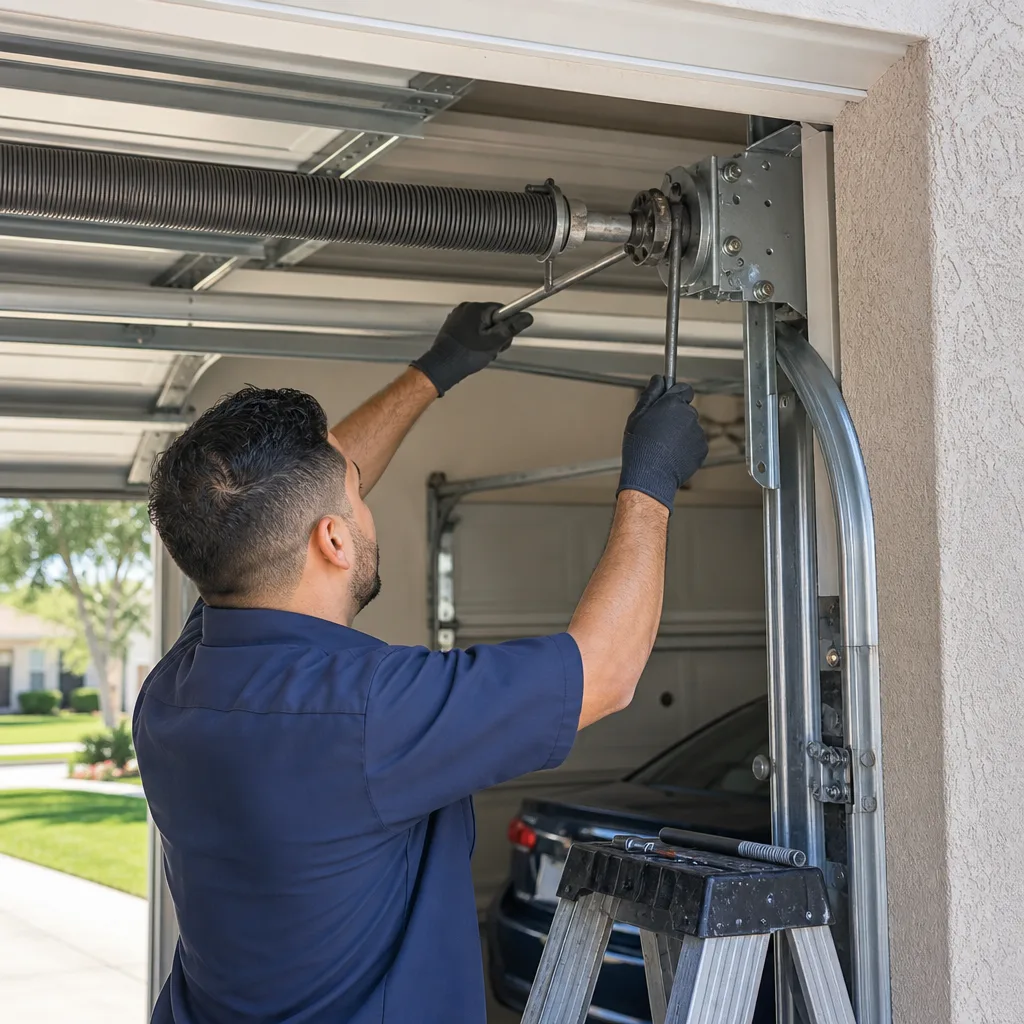
Spring replacement is not a DIY job. A torsion spring under tension stores enough energy to break bone or worse if it releases wrong. This is the one component where the line between professional repair and a hospital visit is very real. When you see the signs, call someone who replaces springs weekly, not someone who watched a video once.
Our Otto’s Garage Door home service area covers Cinco Ranch and the surrounding county, and spring replacement is the most common emergency call we run. We quote the price on the phone and hold it.
Roller and Track Wear: What Those Side Noises Mean
Your garage door rides up and down on rollers that travel inside metal tracks mounted to the wall and ceiling. Those rollers are the only moving contact point between a 200-plus-pound door and the house it’s attached to. When a roller fails, the door doesn’t just get noisy; the load shifts to the remaining rollers, and they fail faster.
Roller failure sounds like chattering, squealing, or a rhythmic thump-thump-thump as one flat spot passes each section. The roller itself is a small wheel mounted on a stem. The stem fits into a hinge. Over time, the ball bearings inside the wheel wear out, the wheel develops flat spots, or the stem bends. On older Cinco Ranch homes with original builder rollers, we see all three.
Track wear shows up differently. Run your finger along the inside edge of the vertical track where the rollers travel. If you feel grooves, scoring, or a ledge where the roller has worn a path, the track is wearing. Track wear is almost always caused by a failing roller, so replacing the rollers early saves you the cost of track replacement later, which is a much bigger job involving realignment of the entire door.
Here’s what you can check without tools:
- Look at the roller wheels themselves. Steel rollers should be round with no visible flat spots. Nylon rollers should be intact with no cracks.
- Watch the door as it travels. A door that shakes or vibrates side-to-side is telling you a roller is seized and dragging.
- Listen for the thump. One rhythm per panel travel distance means one roller has a flat spot. Note which side it’s on.
A full roller replacement on a double-width door runs a few hundred dollars with parts and labor, and it’s the single best noise reduction and reliability upgrade you can make without replacing the door. If your door is loud enough that the neighbors’ dogs bark when it opens, it’s not normal. It’s rollers.
Weather Seal Damage: The Sign You Can See From Your Driveway
Along the bottom edge of your door runs a rubber or vinyl weather seal, usually a T-shaped strip that slides into an aluminum retainer. Its job is to keep water, dirt, and pests out of the garage. It’s also the easiest garage door component to inspect, because you can see it from the driveway without touching anything.
A healthy bottom seal is soft and flexible. It compresses against the concrete and springs back. A worn seal is brittle, cracked, or flattened into a wedge shape. In Cinco Ranch humidity, vinyl seals degrade faster than they do in dry climates because the seal sits against concrete that’s often damp from condensation. A seal that’s five years old on a Texas Gulf Coast garage has done the work of eight years in a drier climate.
Weather seal damage matters for reasons beyond water. A compromised bottom seal is an open invitation for:
- Fire ants: They find the gap and build mounds inside the garage along the walls. Once established, they’re harder to remove than a bad seal.
- Rodents: A half-inch gap at the floor line is a front door for rats and mice. Cinco Ranch garages offer warmth, shelter, and often pet food or grass seed.
- Hot air and humidity: An unsealed garage stays hotter and wetter, which accelerates rust on everything in it, including the door itself.
- Water intrusion: Heavy Texas thunderstorms drive water under an unsealed door, and that water finds its way into drywall, tools, and whatever else you store on the floor.
Replacing a bottom seal is a straightforward job on most doors, and it’s one of the few garage door tasks a handy homeowner can do themselves. The seal slides out of the retainer, and the new one slides in. The catch is getting the right seal dimensions for your specific door. A seal that’s too thin lets water through. One that’s too thick binds when the door closes and can trip the reversal system. If you’re not sure what size your door uses, describe it over the phone and we’ll tell you what to buy.
For a full door replacement that includes a new, properly fitted weather seal, see our garage door installation in Cinco Ranch page or call us for a free measure and written price.
Common Mistakes to Avoid
- Ignoring a popping spring because “it still works.” A door with a broken torsion spring can still open if the opener drags it up, but every open does further damage to the opener, the cables, and the other spring. The second spring always fails shortly after the first.
- Replacing the remote battery for a door that hesitates. If the door hesitates from the wall button too, the battery was never the problem. The opener motor is failing, and every day of hesitation is borrowed time.
- Spraying WD-40 on everything that squeaks. WD-40 is a solvent, not a roller lubricant. It strips away the existing lubricant and leaves the rollers drier than before. Use a garage door-specific lubricant, and only on the hinges and pulleys, never on the rollers themselves.
- Adjusting the reversal force to fix a door that reverses on nothing. When a door reverses with no obstruction, the force setting is too sensitive or the door is unbalanced. Turning up the force masks the real problem, and it means the door won’t reverse for a real obstruction either.
- Replacing the bottom seal on an uneven door. A new seal cannot fix a door that sits crooked. If you see daylight on one side, check the cables and drums before replacing the rubber.
- Disconnecting the opener and forcing the door up by hand after a spring breaks. A door with no spring support weighs several hundred pounds. Lifting it manually puts you under it. That’s how hernias, crushed fingers, and worse happen. Leave it alone and call a professional.
- Waiting until “it completely fails” to budget for opener replacement. In Cinco Ranch, opener failure happens on the hottest days when the capacitor is already stressed. A $300 replacement planned in March beats an $800 emergency call in August.
When to Call a Professional
Call a professional the same day you hear a popping sound from the spring area. Call within the week if your door fails the safety reversal test, or if it hesitates before moving from the wall button. Call for a cable inspection if your door closes unevenly and the gap is growing. And call before the rust blisters into pinholes through your bottom panel; a panel replacement is cheaper than a door replacement, but only if you catch it in time.
For more guides & resources, visit our blog, or call Otto’s Garage Door for free estimates in Cinco Ranch. Call (346) 586-0344, and the person who answers will be the one who shows up, quotes the price on the phone, and holds it at the door.
Frequently Asked Questions
Garage door spring replacement in Cinco Ranch typically runs between $180 and $340 for a standard residential torsion spring pair, depending on spring size and door weight. The price is quoted before any work starts and does not change between the phone call and the driveway. Call (346) 586-0344 for an exact quote on your door.
Yes, same-day repair is available for broken springs, snapped cables, and most opener failures. Emergency calls are answered by a live person around the clock, and many repairs are completed on the first visit. Call (346) 586-0344 and describe what you’re hearing; you’ll get a straight answer about timing.
A loud bang or pop is almost always a torsion spring breaking or starting to separate. It’s the sound of steel releasing stored tension, and it means the door should not be operated until the spring is replaced. A single pop might happen weeks before the spring fully fails, but the safe decision is to stop using the door immediately.
Test the safety reversal every month. The test takes thirty seconds using a paper towel roll or a 2×4 laid flat under the door. A door that doesn’t reverse within two seconds of contact is a safety hazard and should be checked by a professional that week.
Yes. Morning condensation forms on the interior face of steel panels and along the bottom seal, and over time that moisture causes rust staging along panel bottoms and bracket points. Vinyl seals also degrade faster in humid air. The damage is preventable with regular inspection and prompt treatment of early rust.
Not usually. If the door hesitates whether you use the remote, the wall button, or the keypad, the problem is inside the opener, typically a failing capacitor or worn drive gear. Replacing remote batteries will not fix it. A door that hesitates consistently needs opener service before it fails completely.
The Bottom Line
Your garage door tells you when it’s in trouble. The scraping roller, the grinding opener gear, the popping spring, the uneven close, the hesitation before movement: each one is a specific signal with a specific fix and a specific urgency. Learn to read them, run the reversal test monthly, and treat rust and seal damage before they spread. A door you maintain is a door that returns the favor in quiet, predictable service for another decade. A door you ignore will eventually announce itself with a crash and an emergency bill. In Cinco Ranch, where the garage is the real front door of most homes, paying attention is the cheapest insurance you can buy.
Written by Otto Reinhardt, Owner at Otto’s Garage Door, serving Cinco Ranch since 2004.